SOL takes a step forward in the race for decentralized blockchain innovation as it introduces its new layer 2
Blockchain technology has grown at an exponential pace throughout time. Following the publication of the Bitcoin white paper in 2008 and the launch of the ETH network a few years later in 2014, a wide variety of new actors have steadily begun to enter the space, seeking to take part in the expansion of the crypto ecosystem.

Because Bitcoin
March 8, 2023
Blockchain technology has grown at an exponential pace throughout time. Following the publication of the Bitcoin white paper in 2008 and the launch of the ETH network a few years later in 2014, a wide variety of new actors have steadily begun to enter the space, seeking to take part in the expansion of the crypto ecosystem.
During the last years, we’ve witnessed a whole new crowd of participants venture into this exciting industry. Developers, venture capitalists, founders, and passionate individuals from around the globe have devoted their resources to the evolution of blockchain technology.
This is where Solana comes in, one of the fastest growing projects within the crypto space. The decentralized blockchain protocol has been backed by multiple wealthy venture capital investors since its very early stages, this has positioned the project as one of the most important players in the race for decentralized blockchain innovation.
What is the Solana ecosystem ?
Solana is a decentralized blockchain protocol created to enable user-friendly and scalable applications for the world. Its main objective is to help optimize other decentralized finance (DeFi) applications, decentralized apps (DApps) and smart contracts, through its unique hybrid proof-of-stake and proof-of-history mechanisms, powered by its native token $SOL, in order to process transactions quickly and securely.
The $SOL network has won its spot primarily by becoming the world’s fastest blockchain. A new block is generated every 400 milliseconds, and has much lower fees than Ethereum. What started as a crypto venture in 2018 is now ranked among the top 10 cryptocurrencies worldwide, with a market cap of around 12 billion USD.
But it doesn’t end there, the SOL network has recently announced its brand new layer 2 “Nitro labs”, which is intended to combine Solana’s powerful execution environment with the thriving Cosmos ecosystem.
But before diving any deeper, let’s first define what a layer 2 is, for those who aren’t familiar with the matter.
A Layer 2 refers to a secondary framework or protocol that is built on top of an existing blockchain system. The main goal of these protocols is to solve the transaction speed and scaling difficulties that are being faced by the major cryptocurrency networks.
Source: Nitro Labs
Incubated by contributors at Sei Labs, Nitro provides a platform for Solana developers looking to expand to the IBC markets.
This exciting innovation will enable developers around the world to easily launch their Solana dApps on Nitro and access the broader Cosmos and IBC ecosystem.
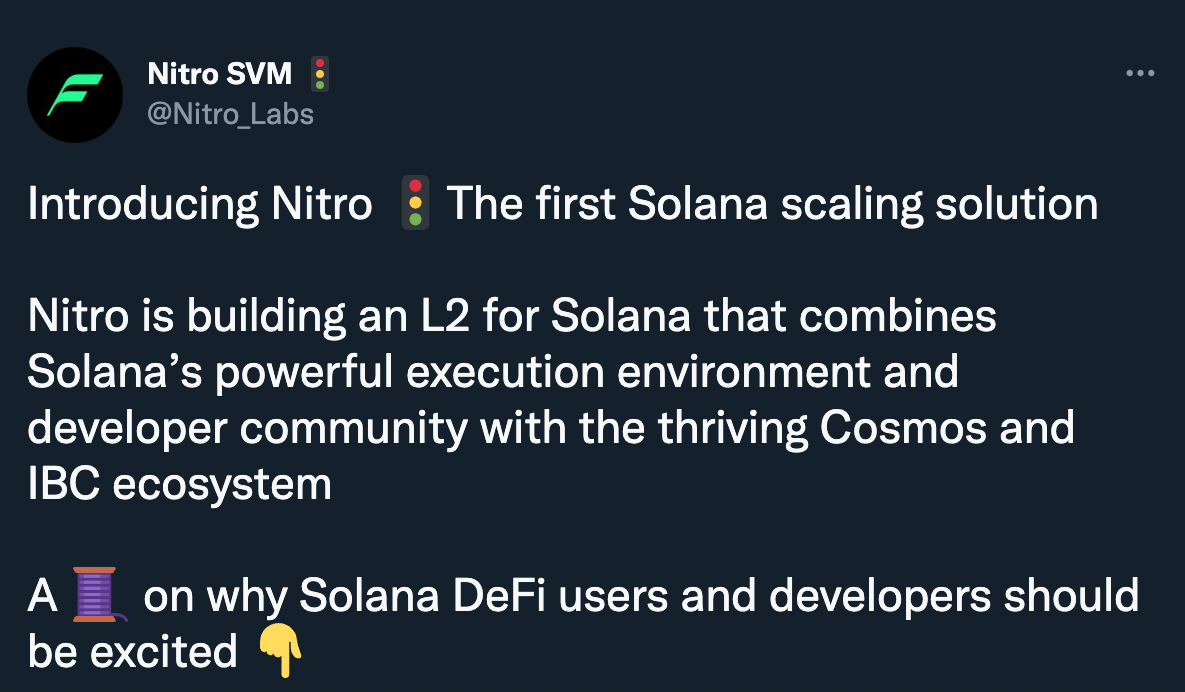
For a further, and more in depth explanation, check out Nitro lab’s latest Twitter thread where they give a detailed rundown of the benefits that this development will provide to the blockchain ecosystem.
(https://twitter.com/Nitro_Labs/status/1570400366096949249?s=20&t=IKmRHOyboy7xHKQDNbFxhQ)
Conclusion
The future of DeFi is centered around interoperability & composability, which is the main reason behind the significance behind the creation of Nitro.
Additionally, Solana has fostered an incredible developer community with global reach. This will provide a great environment for developers and crypto enthusiasts in order for them to expand on what has already been built within the Solana and Cosmos ecosystems.