Is The Federal Reserve On a Path For a “Soft Landing”?
FED vice chair foresees the potential for a soft landing as the full impact of last year’s aggressive Fed interest rate increases continue to convey into the real economy.


Valentin
March 13, 2023
As the Federal Reserve and foreign central banks continue to implement restrictive monetary policies within the already weak economy, financial conditions have become increasingly tighter over the past year. However, evidence in favor of a “soft landing” for the U.S. economy, in which inflation declines without major job losses, appears to be growing.
With real yields having seen a significant increase since the beginning of the tightening cycle, a wide variety of challenging economic conditions have arisen as the Federal Reserve’s goal of achieving a “soft landing” for the economy has become increasingly difficult.
Federal Reserve Vice Chair Lael Brainard gave her remarks at the University of Chicago Booth School of Business, Chicago, Illinois on Thursday.
The vice chair argued that, “Inflation has been declining over the past several months against a backdrop of moderate growth” adding that, “significant weakening in the manufacturing sector, a moderation in consumer spending, and other data are pointing to subdued growth in 2023”.
Source: https://www.federalreserve.gov/newsevents/speech/brainard20230119a.htm
Furthermore, Brainard stated that “It is likely that the full effect on demand, employment, and inflation of the cumulative tightening that is in the pipeline still lies ahead,” But according to her, “It remains possible that a continued moderation in aggregate demand could facilitate continued easing in the labor market and reduction in inflation without a significant loss of employment.”
But to leave things clear, “Even with the recent moderation, inflation remains high, and policy will need to be sufficiently restrictive for some time to make sure inflation returns to 2 percent on a sustained basis” Brainard said.
With inflation on the decline, American households, businesses and consumers have started to take a sigh of relief. However, sustained high inflation remains a concern and it will take determined efforts to bring it back to the desired 2 percent level that the Federal Reserve has remained committed to.
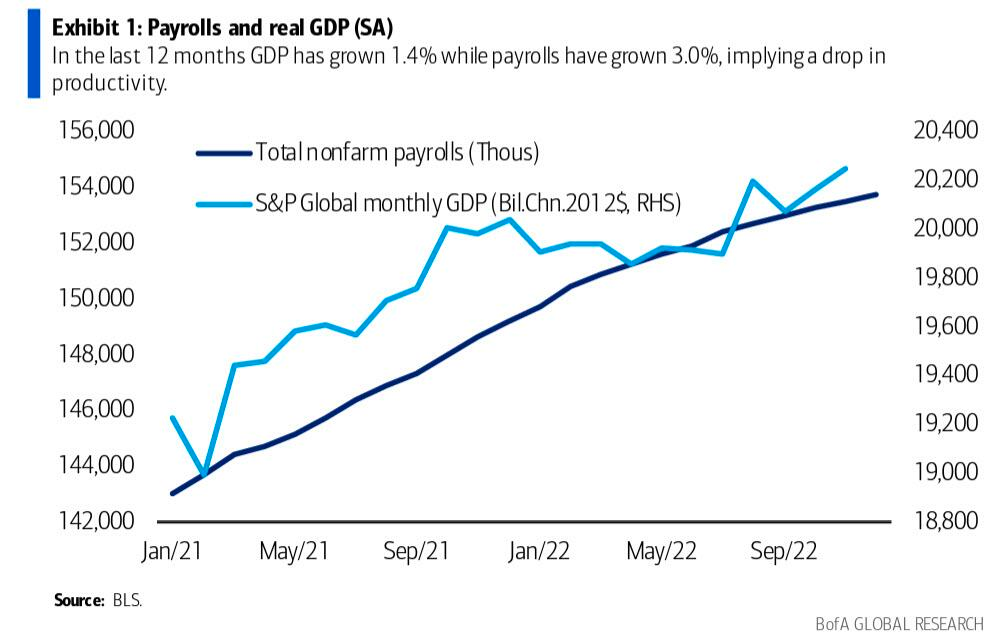
As Bank of America noted today, “the labor market remains stronger than normal, even as the overall economy slips into a growth recession.”
Bottom line
Despite there being a widespread bullish sentiment in the mainstream, Because Bitcoin has held a bearish bias throughout the current environment, as we believe that market conditions are not sustainable and that there is a high risk of a downturn in the near future.
Although the markets are very fragile right now, there could be a wide variety of developments such as overvaluation of assets, economic uncertainty, or geopolitical risks, that ignite the fire that takes us lower in equities and global markets overall.
Ultimately, It all comes down to one thing, either the Fed lets the secular inflation trend continue to run hot, hurting millions of Americans in its way, or they seek to sacrifice growth and labor markets in order to finally restore price stability while bringing demand down (even if this means crashing the U.S economy). As we’ve extensively explained throughout our different articles, it’s clear that the monetary authority has decided for the latter.