Crypto Firm Paxos Will No Longer Issue Binance USD Stablecoin (BUSD)
Paxos, a cryptocurrency company, has been instructed by New York regulators to halt the issuance of one of the most significant cryptocurrencies pegged to the value of the US dollar.

Valentin
March 13, 2023
The Wall Street Journal reported that the New York Department of Financial Services has instructed Paxos Trust Co., the issuer of Binance’s BUSD token, to halt the creation of any more of the dollar-pegged cryptocurrency.
The move comes as the government expands its crackdown on the sector. Despite this directive, Paxos will still be responsible for handling redemptions of the BUSD token, as stated in a statement by Binance.
Furthermore, the Securities and Exchange Commission (SEC) of the United States has reportedly informed Paxos Trust Co. that it plans to sue the stablecoin issuer for violating investor protection laws regarding its Binance USD. According to a report by The Wall Street Journal, the SEC has sent Paxos a Wells Notice, a letter used by the regulator to announce its intention to take enforcement action.

The notice claims that Binance USD is an unregistered security. After receiving a Wells Notice, the accused has 30 days to respond via a Wells Submission, which gives them an opportunity to argue why the charges should not be brought against them.
A spokesperson for Binance stated that BUSD is a product owned and issued by Paxos, and that Paxos is regulated by the New York Department of Financial Services. Paxos is the owner and issuer of BUSD, a dollar-collateralized stablecoin that has been in existence since its partnership with Binance in 2019.
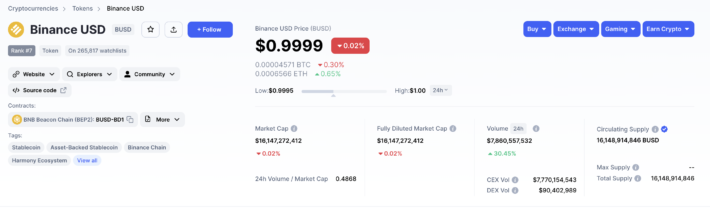
It is currently the third-largest stablecoin with a market cap over $16 billion. In response to the potential action, Binance stated that stablecoins are a crucial safety net for investors, and that limiting access to them would harm millions of people globally.
FED Governor Waller Praises The Emerging Applications Of Crypto Technology
While Christopher Waller praised the advancements of distributed ledger technology, smart contracts, and tokenization, his opinion on cryptocurrency assets was different.