Credit Suisse & Deutsche bank face turmoil amidst insolvency rumors
As the Fed continues to carry out restrictive monetary policies in its relentless battle against inflation, the effects of rising interest rates and tighter financial conditions have slowly started to convey into the real economy.


Because Bitcoin
March 8, 2023
As the Fed continues to carry out restrictive monetary policies in its relentless battle against inflation, the effects of rising interest rates and tighter financial conditions have slowly started to convey into the real economy.
This situation has naturally caused many problems among global financial markets, given that liquidity is starting to dry up in a completely indebted and overleveraged economy, inflated assets around different sectors have been sharply selling off since the beginning of the year.
As a result, some of the biggest financial institutions around the world have been vividly suffering the effects of this abrupt tightening of financial conditions. Rumors of a major global bank facing potential insolvency issues have been sounding the alarms since last week.
Although the reports didn’t specify any names, people familiar with the matter have alluded to both Credit Suisse & Deutsche bank as the potential subjects which the rumors are referring to.
The Swiss firm is headquartered in Zürich and is considered one of the leading institutions in private banking and asset management, with a strong expertise in investment banking. Making it one of the most prestigious financial institutions in the world.
As for the German multinational investment bank, Deutsche Bank AG, it’s the biggest financial services company in Germany and it’s headquartered in Frankfurt.
Credit Suisse currently holds approximately $829.12bn worth of assets, while Deutsche Bank holds a staggering $1,505.74bn. Together, both institutions amass a total of nearly $2 Trillion, which to put things into perspective, is 4 times more than the asset base of Lehman Brothers when it filed for bankruptcy on September 15 of 2008, in what until now, is considered the single largest bankruptcy filing in the history of the US. At the time, the bank had $639 billion in assets and $619 billion in debt.
As of now, credit markets are pricing in a high chance of default as credit default swaps (CDS) – which are essentially financial derivatives purchased as insurance against a potential default – for Credit Suisse trade at their highest level since the peak of the Great Financial Crisis.
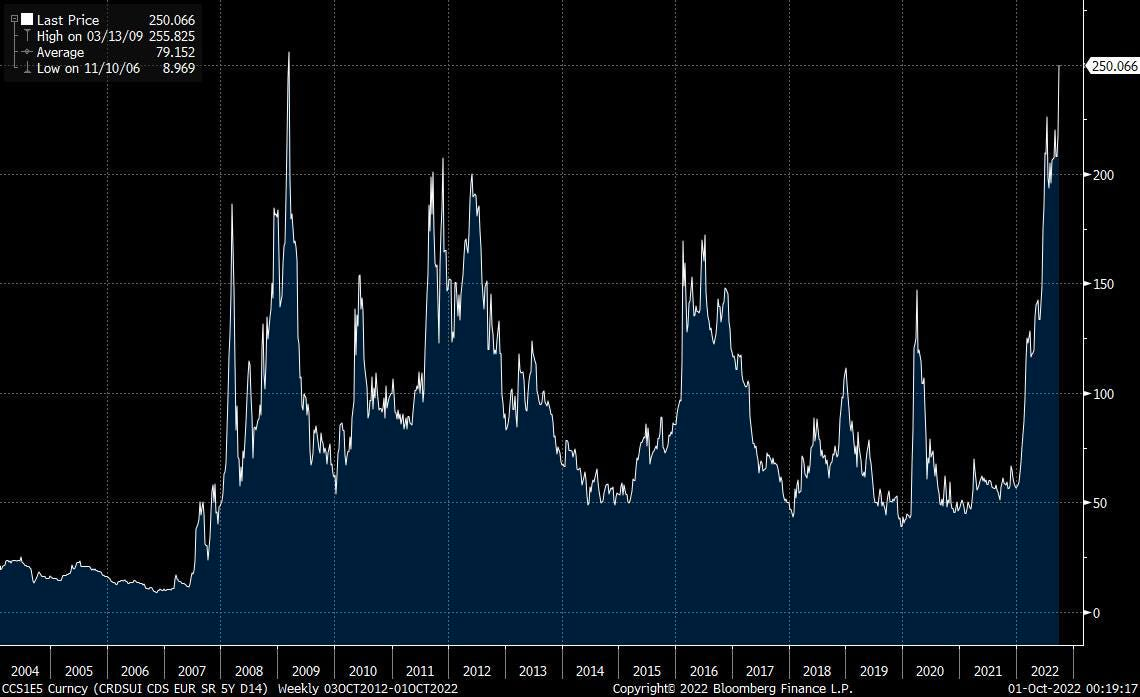
A collapse of this magnitude would trigger a massive deleveraging event, which in turn could provoke a dangerous reinforcing spiral, as other institutions rush to sell their assets in order to pay their obligations and remain solvent. If this were to happen, the pace in which the economic meltdown would spread from one market/region to another would grow exponentially.
As a response to the unconfirmed claims, Credit Suisse’s Chief Executive Officer, Ulrich Koerner, said that “the bank is at a critical moment as it prepares for its latest overhaul” (Source: https://www.bloomberg.com/news/articles/2022-09-30/credit-suisse-ceo-says-firm-at-critical-moment-sees-strength), in an effort to reassure investors and global market participants that the Swiss bank remains solvent.
The road ahead.
Although the current situation regarding the bank’s health seems extremely alarming to say the least, it’s important to consider that this is still a developing story with a lot of rumors swirling around.
It’s also a good time to remind our readers that although financial institutions around the globe are suffering the secondary effects of tighter liquidity derived from the Fed’s fight against inflation, the banking system, and especially US banks, look nothing like 2008.
As Lyn Alden Investment Strategy founder, Lyn Alden, stated through a recent twitter post: “Lightning rarely strikes the same place twice, especially because protection gets put on what was struck” (https://twitter.com/LynAldenContact/status/1576604797557698560?s=20&t=I_oA6rB2pGyW3dEYMn5kSA).
As for the crypto markets, which are still considered as a highly speculative risk on asset, an event of this magnitude could potentially be catastrophic given that the contagion effect of an economic collapse would undoubtedly hit the sectors which are extremely overleveraged the hardest.