Coinbase Has Reached a Settlement of $100 Million With New York Regulators
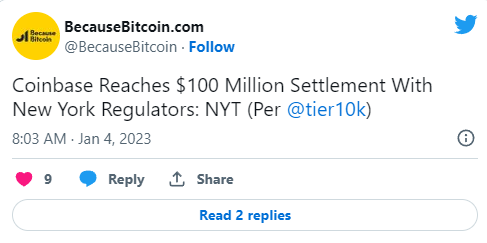
As part of the settlement, the U.S. crypto exchange will pay a $50 million fine for inadequate background checks on customers and will also spend $50 million to improve compliance with regulations.


Valentin
March 11, 2023
The New York Times has reported that Coinbase, a US-based cryptocurrency exchange, has agreed to pay a $50 million fine after financial regulators discovered that it had allowed customers to open accounts without completing necessary background checks, a violation of anti-money-laundering laws.
The settlement, reached with the New York State Department of Financial Services, will also require Coinbase to invest $50 million in its compliance program to prevent potential lawbreakers, such as drug traffickers and sellers of child pornography, from opening accounts on the exchange.
The fine is the latest blow to the cryptocurrency trading industry, which has seen several firms file for bankruptcy in the past year, including FTX, the world’s second-largest crypto exchange before it collapsed in November. The founder of FTX, Sam Bankman-Fried, and other top executives are currently facing federal criminal charges.
Regulators in New York first detected compliance issues at Coinbase during a routine examination in 2020, after the exchange obtained a license to operate in the state in 2017. The investigation revealed that Coinbase had inadequate anti-money-laundering controls in place as far back as 2018.
In response, the company initially agreed to hire an independent consultant to improve its operations and comply with anti-money-laundering regulations. However, these efforts were unsuccessful, and regulators launched a formal investigation in 2021. The exchange was found to have failed in two key areas: conducting thorough background checks on customers with unclear identities and properly investigating suspicious activity alerts generated by its internal monitoring system.
Coinbase takes little responsibility
According to the Department of Financial Services, by late 2021, Coinbase had a backlog of over 100,000 alerts regarding potentially suspicious customer transactions that were not being properly investigated. Regulators also found that Coinbase performed minimal “know your customer” checks on individuals before allowing them to open accounts, treating the process as a mere formality. In one instance, Coinbase aided a digital thief in stealing $150 million from an unnamed company by allowing the thief to open a Coinbase account while posing as an employee of the company.
The exchange’s inadequate background check procedures prompted regulators to order Coinbase to hire an outside monitor, in addition to the independent consultant the company had already agreed to bring on, to oversee its compliance efforts even as the formal investigation was ongoing.

Adrienne A. Harris, New York State’s Superintendent of Financial Services, stated in an interview that the failure to properly review older accounts for suspicious activity warranted the appointment of an independent monitor rather than waiting for a settlement. The settlement requires Coinbase to continue working with the monitor for at least another year as it implements systems to improve its compliance operation.
New York regulators did not disclose the identity of the monitor. Ms. Harris indicated that Coinbase’s compliance department had been unable to keep pace with the exchange’s rapid growth. Coinbase, which was founded in San Francisco in 2012, has a market capitalization of over $7.6 billion and is the largest crypto trading platform in the United States, with 100 million users worldwide. Most of its competitors are based in jurisdictions with lighter regulations, such as FTX, which is based in the Bahamas.
U.S. authorities have been concerned about the potential for the cryptocurrency industry to undermine global anti-money-laundering measures due to the industry’s history of evading regulation. The cryptocurrency industry emerged without the oversight and scrutiny that is standard for banks, insurance companies, investment firms, and brokerages.
Over the past decade, state and federal authorities have taken steps to bring exchanges like Coinbase and their overseas counterparts into compliance. New York was one of the first states to require crypto firms to obtain licenses, known as BitLicenses, before doing business with state residents. To date, the state has issued around 30 such licenses.