Breaking The $31.41 Trillion Ceiling: The Looming U.S Debt Crisis
The Treasury Department announced that it will implement a series of financial maneuvers in order to prevent the United States from exceeding its debt limit.


Valentin
March 13, 2023
The United States debt ceiling, also known as the statutory debt limit, is a legislative limit on the amount of national debt that the U.S government is authorized to issue.
This limit has been a contentious issue in recent years, as the government has struggled to find a balance between reducing the national debt and maintaining the ability to fund important programs and services. The debt ceiling has been raised multiple times in the past, but each time it is raised or (congress kicks the can down the road), it brings with it new concerns about the sustainability of the national debt and the potential for economic crisis.
And as it was expected, the United States has once again reached its debt ceiling. This limit was temporarily suspended in 2019 and was re-established in 2020, allowing the government to continue borrowing money to fund its operations. However, the ongoing COVID-19 pandemic and the subsequent economic downturn have led to increased government spending on stimulus packages and other measures to support individuals and businesses. This, combined with the already large national debt, has led to the government approaching the debt ceiling once again.
As previously anticipated, Treasury Secretary Janet Yellen informed House Speaker Kevin McCarthy in a letter, that as of January 19, the country’s debt was projected to reach the legal limit and that the Treasury Department has started to implement “extraordinary measures” to avoid breaching the debt ceiling.
Source: https://home.treasury.gov/news/press-releases
The letter, which included further information, argued that “The period of time that extraordinary measures may last is subject to considerable uncertainty, including the challenges of forecasting the payments and receipts of the U.S. government months into the future.” Ms. Yellen further stated, “I respectfully urge Congress to act promptly to protect the full faith and credit of the United States.”
Something to take into account is that, The “debt issuance suspension period” will commence on January 19, 2023, and extend until June 5, 2023. This means that the government will not be able to borrow any more money during this time and will have to rely on shifting assets and liabilities, causing the Treasury’s cash reserves to be depleted rapidly in the upcoming months. It is likely that the government will not be able to resume borrowing until September or October.
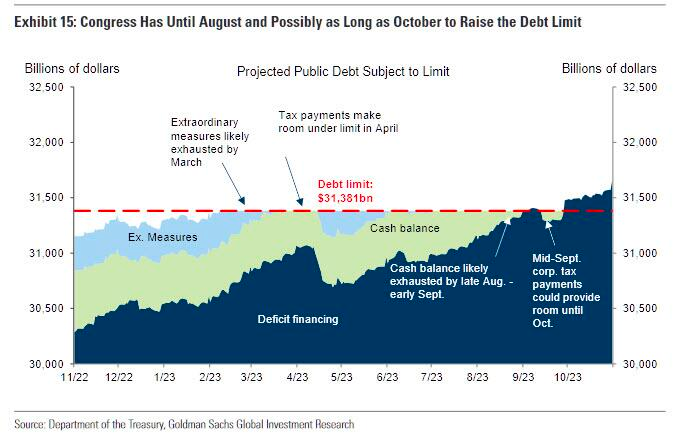
If the government is unable to borrow any further, it would not have sufficient funds to meet all its financial obligations in a timely manner, including paying interest on the national debt. This could result in the government temporarily delaying payments or defaulting on some of its commitments which would have a significant impact on Social Security payments, veterans’ benefits, federal employees’ salaries, and other important programs. But we all know how this story ends…
Bottom line
If history works as any indication, we can clearly infer that the debt ceiling will just be raised again and again, without any real plan to address the underlying issues that continue to drive up the debt. It’s like a never-ending game of whack-a-mole, where they just keep hitting one problem, only for another to pop up.
Time has shown that the debt ceiling is just another political game that the government plays to make it seem like they are doing something about the national debt, while decision-makers in our government are more interested in scoring political points than in providing real solutions.