Brad Garlinghouse Targets $180K Bitcoin by 2026, Ties Upside to U.S. Policy Clarity
Ripple’s Brad Garlinghouse set a $180K Bitcoin target for end-2026, leaning on U.S. regulatory progress like the CLARITY Act. How policy timing could shape BTC’s next leg higher.

Because Bitcoin
December 5, 2025
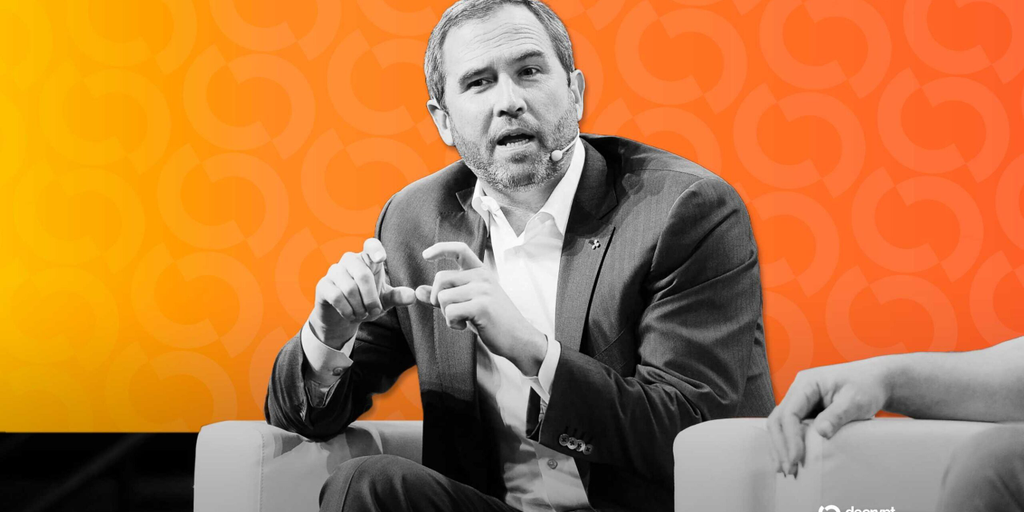
Bitcoin’s latest bold price call isn’t coming from a trader—it’s coming from a CEO. Onstage at Binance Blockchain Week, Ripple chief Brad Garlinghouse said he expects Bitcoin to trade at $180,000 by the end of 2026. He didn’t present a specific valuation model, but he anchored the outlook to improving U.S. policy—highlighting the long-stalled CLARITY Act and arguing that legislative progress could accelerate adoption across the asset class.
Garlinghouse said his team has pushed for clearer rules in the United States under what’s commonly referred to as the CLARITY Act, and he anticipates movement not this year, but sometime in the first half of next year. In his view, passage would “unlock” more participation and provide a tailwind for crypto broadly.
That confidence faces a skeptical market. On Myriad, a prediction market operated by Dastan, traders assign just a 25% chance that the Senate Banking Committee approves a crypto market structure bill before 2026 wraps. The gap between executive optimism and market-implied odds is the crux here: if policy momentum slips, the timing leg of a 2026 price target becomes fragile.
His fellow panelists opted for restraint. Solana Foundation President Lily Liu forecast Bitcoin “above $100,000” by the end of next year, while Binance CEO Richard Teng kept it qualitative, saying BTC should be stronger than it is today.
Meanwhile, the scoreboard: Bitcoin is up roughly 1% on the week, recently changing hands around $92,417—still about 27% below its all-time high. To hit $180,000 by Garlinghouse’s deadline, price would need to climb near 95% and push decisively past the current record above $126,000. Traders on Myriad have turned constructive in the near term, now skewed toward $100,000 arriving before any retrace to $69,000.
Context matters with price calls. Earlier this year, BitMine Immersion Technologies Chairman Tom Lee said Bitcoin could reach $150,000-$200,000 by year-end, then tempered that view in late November to a “maybe” $150,000. Michael Saylor has kept his $150,000 year-end stance intact—even after an early-October washout that saw roughly $19 billion liquidated—while maintaining longer arcs of $1 million per coin in four to eight years and $20 million within two decades. Cathie Wood, by contrast, trimmed her 2030 target from $1.5 million to $1.2 million, citing how quickly stablecoins have scaled.
Why focus on policy? Because market structure is the invisible plumbing that governs who can buy, how they custody, and what mandates allow. If a version of the CLARITY framework advances in the first half of 2026, expect incremental effects rather than a switch-flip: more comfortable compliance postures at banks and brokers, clearer treatment for token classifications, smoother routing for ETFs and retirement platforms, and fewer career-risk barriers for institutional allocators. Those shifts often precede sustained net inflows.
Still, legislation is messy. Committee calendars slip, amendments dilute scope, and rulemaking lags implementation. Prediction markets assigning only one-in-four odds to approval by 2026 year-end reflect that drag. When CEOs put a headline number on stage, they are often conditioning for a scenario—if the framework lands, capital follows—and compressing a complex policy path into a single date. It’s not unusual, but it puts the burden on the legislative clock rather than hash rate, halvings, or onchain economics.
For positioning, that means traders may want to map catalysts to the Hill: committee markups, whip counts, and any CLARITY Act compromises. Those dates can skew options pricing, shift basis, and reset narrative momentum. If the bill moves, risk budgets tied to governance constraints could expand; if it stalls, expectations may need a reset even if fundamentals elsewhere remain constructive.
A $180,000 print by end-2026 is possible if U.S. rules meaningfully reduce friction and unlock new pools of demand. The market appears to agree that higher prices are plausible—just not yet willing to underwrite the legislative timeline with conviction.